In the fast-paced internet era, website loading speed has become a crucial factor in determining the success of any digital presence. Users no longer have the patience to wait for slow pages to load, and search engines are paying increasing attention to fast websites when ranking search results. With the immense development in Artificial Intelligence (AI) technologies, it is now possible to harness these technologies to improve website speed with AI like never before, providing an exceptional user experience and enhancing visibility in top search results.
This article aims to provide a practical guide and clear steps on how to leverage Artificial Intelligence to increase your website's speed, focusing on the technical aspects and available tools that can make a significant difference in your website's performance.
Why is it Important to Increase Website Speed with AI?
The importance of website speed with AI extends beyond merely providing a pleasant user experience; it directly impacts several vital aspects of any website's success:
1. Enhancing User Experience (UX)
Website speed is a fundamental element in determining the quality of user experience. Slow websites lead to visitor frustration and increased bounce rates, as users leave the page before it fully loads. Studies indicate that a mere one-second delay in page load time can significantly reduce user satisfaction and conversion rates. For instance, Amazon found that accelerating its site by just 0.01 seconds could increase sales by 1%.
2. Enhancing Search Engine Ranking (SEO)
Website speed is a significant factor in search engine ranking algorithms, especially Google's. Fast websites are favored to appear in the top results, which increases organic traffic. Google specifically focuses on Core Web Vitals metrics, which measure aspects of user experience such as Largest Contentful Paint (LCP), First Input Delay (FID), and Cumulative Layout Shift (CLS). Improving these metrics directly contributes to enhancing your website's ranking.
3. Increasing Conversion Rates and Sales
Website speed is closely linked to conversion rates, whether for purchases, registrations, or downloads. Users who find a website responsive are more likely to complete the desired action. Conversely, slowness can lead to the loss of potential customers to competitors who offer a faster and smoother experience.
How Does AI Contribute to Improving Website Speed?
Artificial intelligence offers innovative and effective solutions to address traditional challenges facing website speed through several mechanisms:
1. Automation and Automatic Optimization
AI technologies enable the automation of many optimization tasks that previously required significant manual intervention. AI-powered systems can continuously analyze website performance and automatically apply necessary improvements, such as image compression, code minification, and caching management, without the need for developer input.
2. Predictive Analysis of User Behavior
AI can analyze user behavior patterns and predict which pages or resources will be requested next. Based on this prediction, the website can preload or proactively cache these resources, significantly reducing the actual waiting time for the user.
3. Smart Resource Optimization
AI excels at analyzing different types of resources (such as images, videos, and code) and determining the best optimization methods for each. For instance, it can compress images to the maximum possible extent without affecting their visual quality, or identify unnecessary code that can be deferred or completely removed.
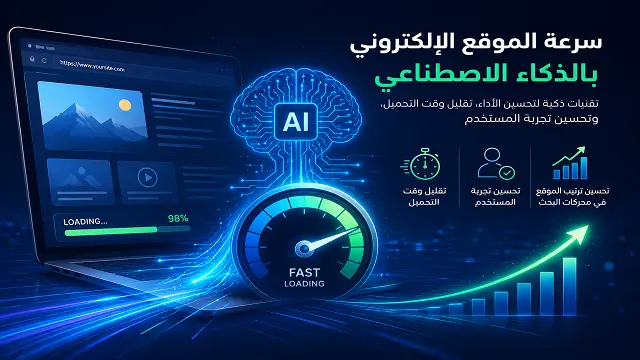
Methods to Increase Website Speed Using Artificial Intelligence
There are several practical ways to apply AI to increase your website's speed:
1. Smart Image Compression and Conversion
Images are one of the biggest factors affecting page loading speed. AI uses advanced algorithms to analyze images and determine the best compression settings for each image individually, while maintaining its quality. It can also automatically convert images to modern and more efficient formats like WebP, which offer significantly smaller file sizes compared to JPEG and PNG.
2. Code Optimization (CSS, JavaScript, HTML)
AI can analyze CSS, JavaScript, and HTML files to identify unused or duplicated code, removing or minifying it to reduce file sizes. It can also identify code that can be deferred until the visible content of the page is loaded first, thereby improving the Largest Contentful Paint (LCP) speed.
3. Using AI-Powered Content Delivery Networks (CDNs)
Content Delivery Networks (CDNs) are essential for delivering content quickly to users worldwide by storing copies of your website on geographically distributed servers. When AI is integrated with a CDN, it can predict requests and route users to the nearest server containing the requested content more efficiently, even proactively distributing content to servers where it is expected to be needed.
4. Smart Caching
AI works to optimize website caching strategies by identifying which content should be cached and for how long, based on usage patterns and content updates. This reduces the number of requests to the origin server, significantly speeding up page loading.
5. Predictive Performance Optimization
AI systems can monitor website performance in real-time, identify potential bottlenecks, and even predict issues before they occur. For example, AI can anticipate increased traffic and automatically adjust server or CDN settings to handle the load, ensuring continuous high performance.
Conclusion
In conclusion, optimizing website speed is no longer a luxury but a paramount necessity for ensuring success in the current digital landscape. AI provides powerful tools and solutions to automate and effectively improve this process, enabling websites to deliver a superior user experience, achieve better search engine rankings, and increase conversion rates. By embracing these smart technologies, website owners can ensure they stay ahead of the competition and offer the best to their audience.
Start exploring AI-powered tools and techniques today to transform your website's performance and maximize your digital presence.
Frequently Asked Questions
Does AI affect image quality when compressing them?
No, modern AI-powered tools are designed to compress images with the maximum possible efficiency while maintaining their visual quality. These tools use advanced algorithms to analyze each image and apply optimal compression without noticeable quality degradation.
Are AI website speed optimization tools free?
Some tools offer free plans with limited features, while more advanced and comprehensive tools require paid subscriptions. For example, Cloudflare offers a free plan, while 10Web Booster and NitroPack provide paid plans with advanced features.
Do I need programming experience to use these tools?
Most AI-powered tools are designed to be user-friendly and do not require deep programming expertise. Their interfaces are usually intuitive and offer automation options to apply optimizations with just a few clicks.
What are Core Web Vitals and why are they important?
Core Web Vitals are a set of metrics launched by Google to measure user experience on the web. They include LCP (Largest Contentful Paint), FID (First Input Delay), and CLS (Cumulative Layout Shift). These metrics are important because they directly affect your website's ranking in Google search results.
Can AI improve the speed of non-WordPress websites?
Yes, many AI technologies, such as smart image compression and CDN usage, can be applied to any type of website regardless of the platform it's built on. Some tools may be specialized for certain platforms (like 10Web Booster for WordPress), but the core principles of AI-powered optimization are broadly applicable.